

Biblical Background
Throughout Scripture, God’s Word is treated with great respect. Jesus, the apostles, and the Old Testament prophets regularly quoted Scripture to teach truth, encourage believers, and proclaim God’s promises.
Jesus said in Matthew 4:4 (NIV):
“It is written: ‘Man shall not live on bread alone, but on every word that comes from the mouth of God.'”
Likewise, Psalm 119:105 (NIV) reminds believers:
“Your word is a lamp for my feet, a light on my path.”
These passages show the importance of accurately sharing and applying God’s Word.
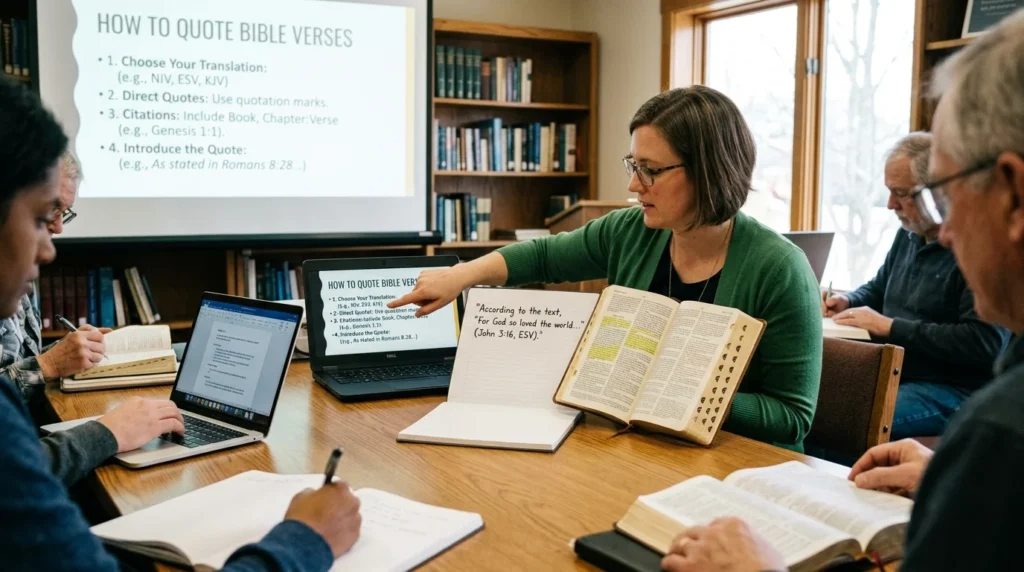
How to Quote Bible Verses
1. Write the Verse Exactly
Copy the verse exactly as it appears in your chosen Bible translation. Avoid changing or adding words unless you clearly indicate any modifications.
Example:
“For God so loved the world that he gave his one and only Son…”
— John 3:16 (NIV)
2. Include the Reference
Always include:
- Book name
- Chapter number
- Verse number
Example:
- John 3:16
- Psalm 23:1
- Romans 8:28
3. Mention the Bible Translation
Because translations differ, identify the version you used.
Examples:
- John 3:16 (NIV)
- Philippians 4:13 (ESV)
- Psalm 46:1 (KJV)
4. Use Quotation Marks
When quoting the complete wording of a verse, place the Scripture inside quotation marks or format it as a block quote for longer passages.
Example:
“Trust in the LORD with all your heart and lean not on your own understanding.”
— Proverbs 3:5 (NIV)
5. Use Block Quotes for Longer Passages
If you’re quoting several verses together, use a block quote instead of quotation marks.
Example:
“The LORD is my shepherd, I lack nothing.
He makes me lie down in green pastures…”
— Psalm 23:1–2 (NIV)
Examples of Bible Verse Citations
In a Church Article
“The LORD is close to the brokenhearted…” (Psalm 34:18, NIV)
In a Social Media Post
“I can do all this through him who gives me strength.” — Philippians 4:13 (NIV)
In an Essay
The Bible teaches believers to trust God completely: “Trust in the LORD with all your heart…” (Proverbs 3:5, NIV).
Spiritual Lessons About Sharing Scripture
Share God’s Word Faithfully
2 Timothy 3:16 (NIV)
Quote Scripture accurately so others receive God’s message as it was written.
Let Scripture Encourage Others
Hebrews 4:12 (NIV)
“For the word of God is alive and active…”
Bible verses have the power to encourage, teach, and strengthen faith.
Speak With Grace
Colossians 4:6 (NIV)
“Let your conversation be always full of grace…”
When sharing Bible verses, do so with humility, kindness, and love.
Live What You Quote
James 1:22 (NIV)
“Do not merely listen to the word… Do what it says.”
God’s Word is meant to be lived out, not simply quoted.
Common Mistakes to Avoid
- Quoting verses without checking the exact wording.
- Forgetting to include the chapter and verse reference.
- Mixing different Bible translations in the same quotation without explanation.
- Taking verses out of context.
- Changing the meaning of Scripture to fit a personal opinion.

Faith-Based Action Steps
Pray Before Reading Scripture
Prayer:
Heavenly Father, thank You for giving us Your holy Word. Help me read, understand, and share Scripture with wisdom, accuracy, and love. Guide me by Your Holy Spirit so that everything I say and write brings honor to You and points others to Jesus Christ. Amen.”
Read the Context
Before quoting a verse, read the surrounding chapter to understand its original meaning. Context helps prevent misunderstandings.
Share God’s Word Wisely
Use Scripture to encourage, teach, and strengthen others rather than to win arguments. Let every Bible verse point people toward Christ and His love.