
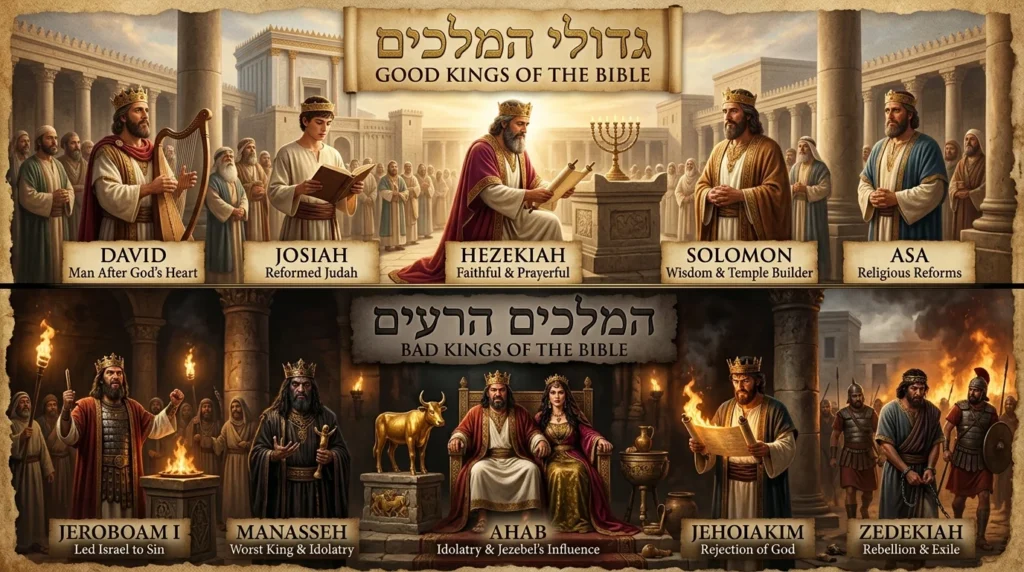
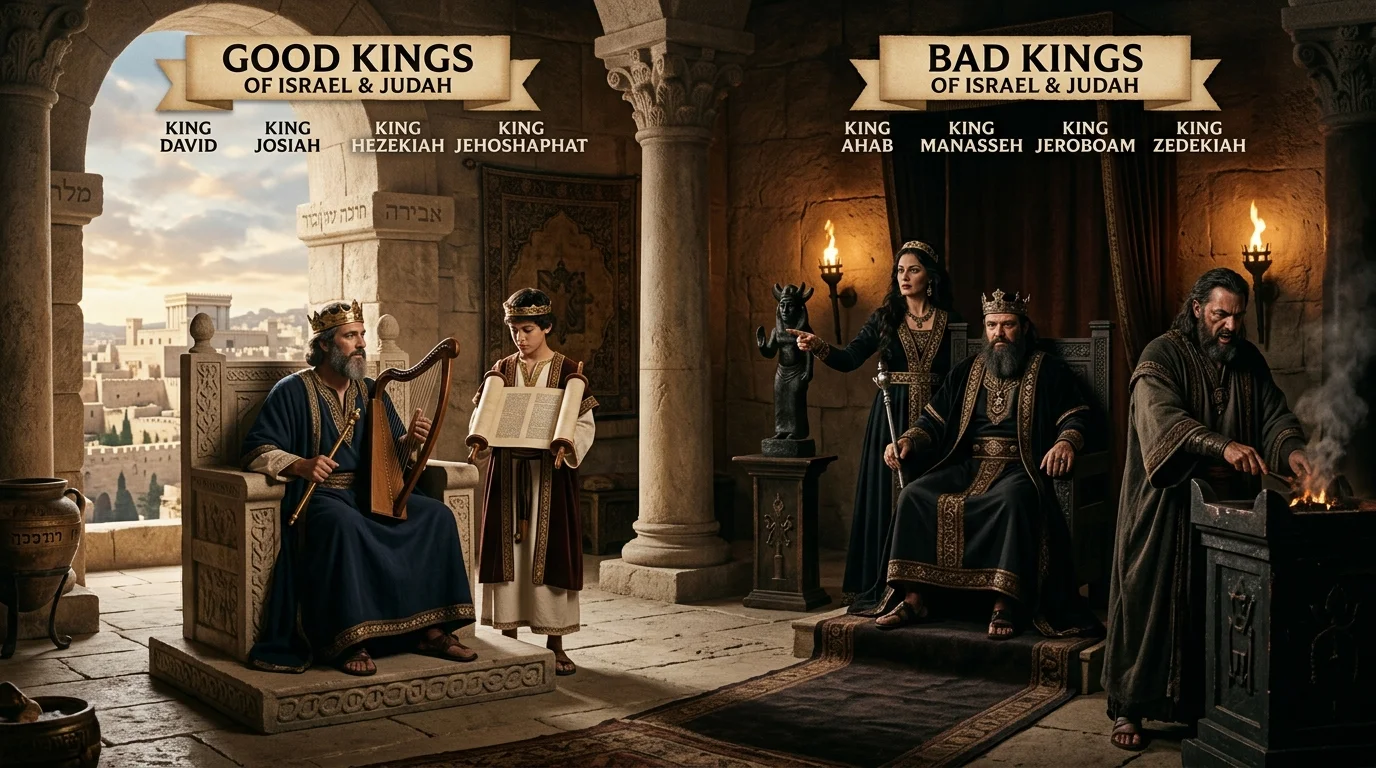
The Kings of Israel and Judah
After King Solomon’s reign, the kingdom divided into:
- Northern Kingdom (Israel) – Had 19 kings, all considered wicked.
- Southern Kingdom (Judah) – Had 20 kings, including some faithful rulers.
List of Good and Bad Kings in the Bible
1. David – A Man After God’s Heart
Reign: Approximately 1010–970 BC
Bible References: 1 Samuel 16–1 Kings 2
David was Israel’s greatest king and established Jerusalem as the centre of worship.
Good Qualities:
- Trusted God in battles.
- United Israel.
- Desired to build God’s temple.
- Repented sincerely after sin.
Acts 13:22 (NIV):
“I have found David son of Jesse, a man after my own heart; he will do everything I want him to do.”
Failure:
- Committed adultery with Bathsheba.
- Arranged the death of Uriah.
Despite his failures, David remained devoted to God and became part of the lineage of Jesus.
2. Asa – Removed Idolatry
Reign: 911–870 BC
Bible References: 1 Kings 15; 2 Chronicles 14–16
Asa was one of Judah’s early reforming kings.
Good Qualities:
- Removed foreign idols.
- Encouraged worship of God.
- Trusted God during battles.
2 Chronicles 14:11 (NIV):
“LORD, there is no one like you to help the powerless against the mighty.”
Failure:
- Later relied on political alliances instead of trusting God.
3. Jehoshaphat – A King Who Sought God
Reign: 873–848 BC
Bible References: 1 Kings 22; 2 Chronicles 17–20
Good Qualities:
- Promoted God’s law.
- Strengthened Judah spiritually.
- Trusted God in battle.
2 Chronicles 17:4 (NIV):
“He sought the God of his father and followed his commands.”
Failure:
- Made poor alliances with wicked kings.
4. Hezekiah – Trusted God During Crisis
Reign: 715–686 BC
Bible References: 2 Kings 18–20; 2 Chronicles 29–32
Hezekiah was one of Judah’s greatest kings.
Good Qualities:
- Destroyed idols.
- Restored temple worship.
- Trusted God against Assyria.
2 Kings 18:5 (NIV):
“Hezekiah trusted in the LORD, the God of Israel.”
Failure:
- Showed pride when Babylonian visitors came.
5. Josiah – The Young King Who Restored God’s Law
Reign: 640–609 BC
Bible References: 2 Kings 22–23; 2 Chronicles 34–35
Josiah became king at eight years old.
Good Qualities:
- Rediscovered the Book of the Law.
- Removed idol worship.
- Led national repentance.
2 Kings 23:25 (NIV):
“Neither before nor after Josiah was there a king like him who turned to the LORD.”
Failure:
- Died in battle after ignoring God’s warning.
Other Faithful Kings of Judah
| King | Main Strength |
|---|---|
| Jehoash (Joash) | Repaired the Temple early in his reign |
| Amaziah | Initially followed God |
| Uzziah | Experienced prosperity while seeking God |
| Jotham | Did what was right before God |
Bad Kings of Judah in the Bible
1. Rehoboam – Divided the Kingdom
Reign: 931–913 BC
Failures:
- Rejected wise advice.
- Increased burdens on the people.
- Caused the kingdom division.
2. Abijah – Continued Sin
Reign: 913–911 BC
Failures:
- Followed many sins of his father.
- Did not fully follow God.
3. Jehoram – Promoted Idolatry
Reign: 848–841 BC
Failures:
- Married Jezebel’s daughter Athaliah.
- Encouraged false worship.
4. Ahaz – Worshipped Foreign Gods
Reign: 732–716 BC
Failures:
- Practised idolatry.
- Sacrificed his children.
- Rejected God’s ways.
5. Manasseh – Judah’s Most Wicked King
Reign: 697–642 BC
Failures:
- Built pagan altars.
- Practised sorcery.
- Led Judah into deep sin.
Later, Manasseh repented and turned back to God.
2 Chronicles 33:13 (NIV):
“When he prayed to him, the LORD was moved by his entreaty and listened to his plea.”
6. Zedekiah – The Last King of Judah
Reign: 597–586 BC
Failures:
- Rebelled against Babylon.
- Refused to listen to God’s warnings.
- Witnessed Jerusalem’s destruction.
Kings of the Northern Kingdom (Israel)
The Bible describes all 19 kings of Israel as wicked because they continued idol worship introduced by Jeroboam.
Major Wicked Kings of Israel
| King | Major Sin |
|---|---|
| Jeroboam I | Created golden calves for worship |
| Nadab | Continued his father’s sins |
| Baasha | Evil leadership and violence |
| Omri | Did more evil than previous kings |
| Ahab | Promoted Baal worship |
| Ahaziah | Followed false gods |
| Jehoram | Continued idolatry |
| Jehu | Destroyed Baal worship but kept golden calves |
| Joash | Continued wrong worship |
| Jeroboam II | Allowed spiritual decline |
| Zechariah | Continued evil |
| Shallum | Murdered the king |
| Menahem | Cruel ruler |
| Pekahiah | Followed sinful practices |
| Pekah | Rebelled against God |
| Hoshea | Last king of Israel |
The Greatest King in the Bible
Jesus Christ – The Eternal King
Although Jesus was not an earthly king ruling Israel, Scripture presents Him as the ultimate King.
Revelation 19:16 (NIV):
“On his robe and on his thigh he has this name written: KING OF KINGS AND LORD OF LORDS.”
Jesus represents the perfect leadership that human kings could never achieve.
Lessons From the Kings of the Bible
1. Leadership Affects Others
The choices of kings influenced entire nations. Godly leadership brings blessing, while sinful leadership brings suffering.
2. God Values Repentance
David and Manasseh show that God forgives those who genuinely turn back to Him.
3. Success Without God Is Temporary
Many kings gained wealth and power but lost their spiritual direction.
4. Faithfulness Matters More Than Status
A king’s greatness was measured not by military victories or riches but by whether he followed God.
Frequently Asked Questions
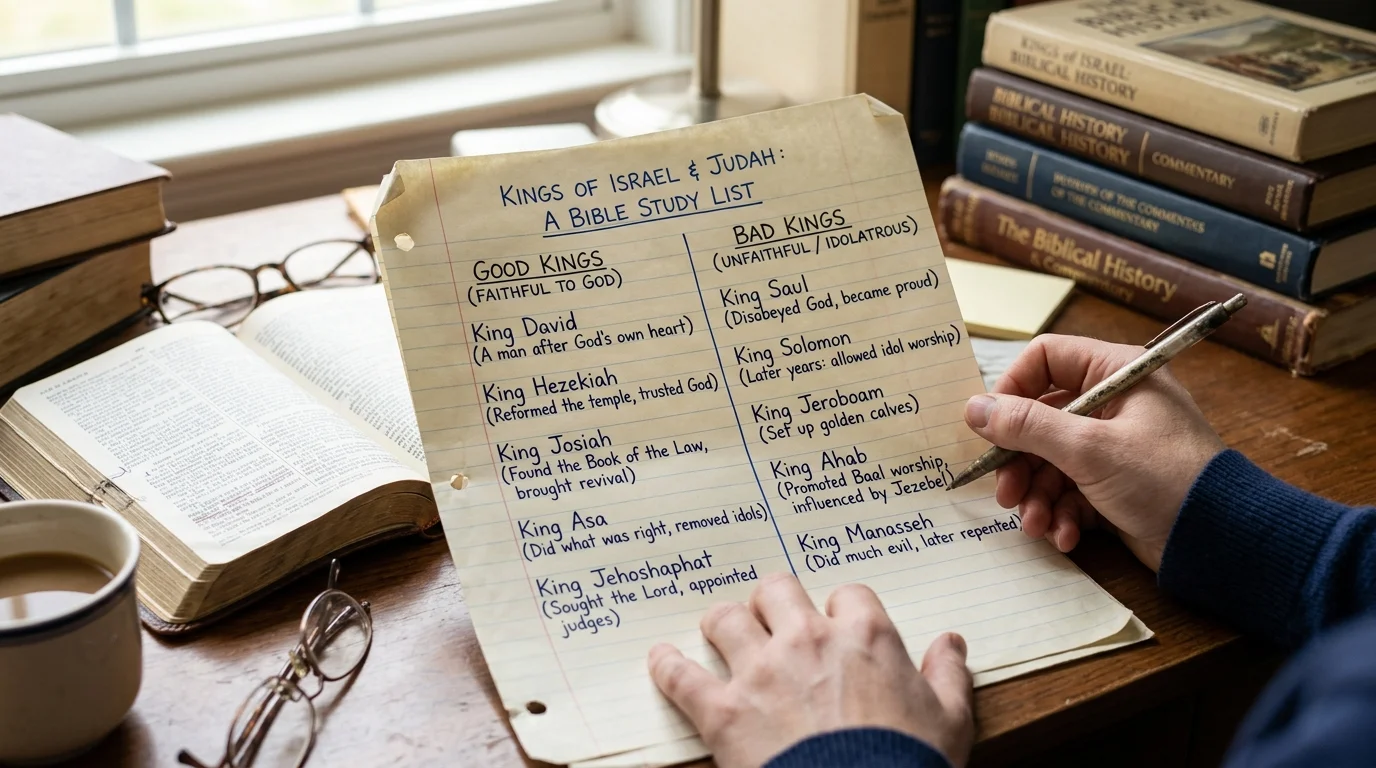
How many good kings were in the Bible?
Judah had several good kings, including David, Asa, Jehoshaphat, Hezekiah, and Josiah. However, the majority of Israel’s kings were considered wicked.
Who was the best king in the Bible?
David is often considered Israel’s greatest earthly king because he was chosen by God and established the royal line that led to Jesus.
Who was the worst king in the Bible?
Manasseh is considered one of Judah’s most wicked kings because of his extreme idolatry, though he later repented.
Were all kings of Israel bad?
According to the biblical accounts, all kings of the northern kingdom of Israel were described as doing evil.
Which king followed God the most?
Josiah and Hezekiah are among the kings most praised for removing idolatry and restoring worship of God.
Who was the first king of Israel?
Saul was the first king of Israel, followed by David and Solomon.