
Biblical Background
Although the Bible contains 66 books, they are not arranged chronologically. Instead, they are grouped by literary style and purpose.
The Old Testament includes:
- Law (Pentateuch)
- History
- Poetry and Wisdom
- Major Prophets
- Minor Prophets
The New Testament includes:
- Gospels
- Church History
- Letters (Epistles)
- Prophecy
The Bible itself emphasizes remembering God’s work throughout history.
Psalm 78:4 (NIV) says:
“We will tell the next generation the praiseworthy deeds of the LORD, his power, and the wonders he has done.”
Likewise, 2 Timothy 3:16–17 (NIV) reminds believers that every part of Scripture is valuable for teaching and spiritual growth.
Printable Chronological Order of the Bible Chart
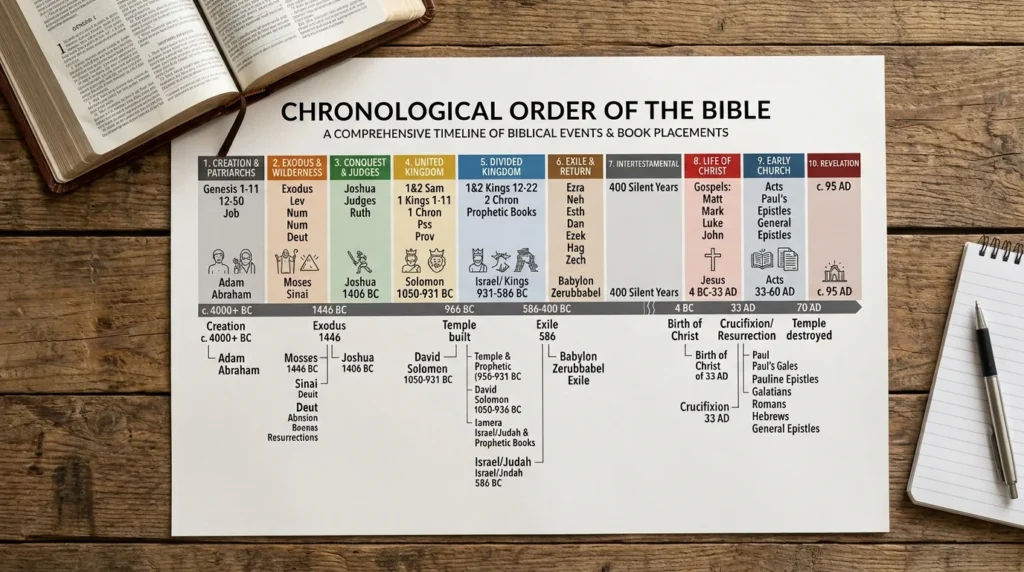
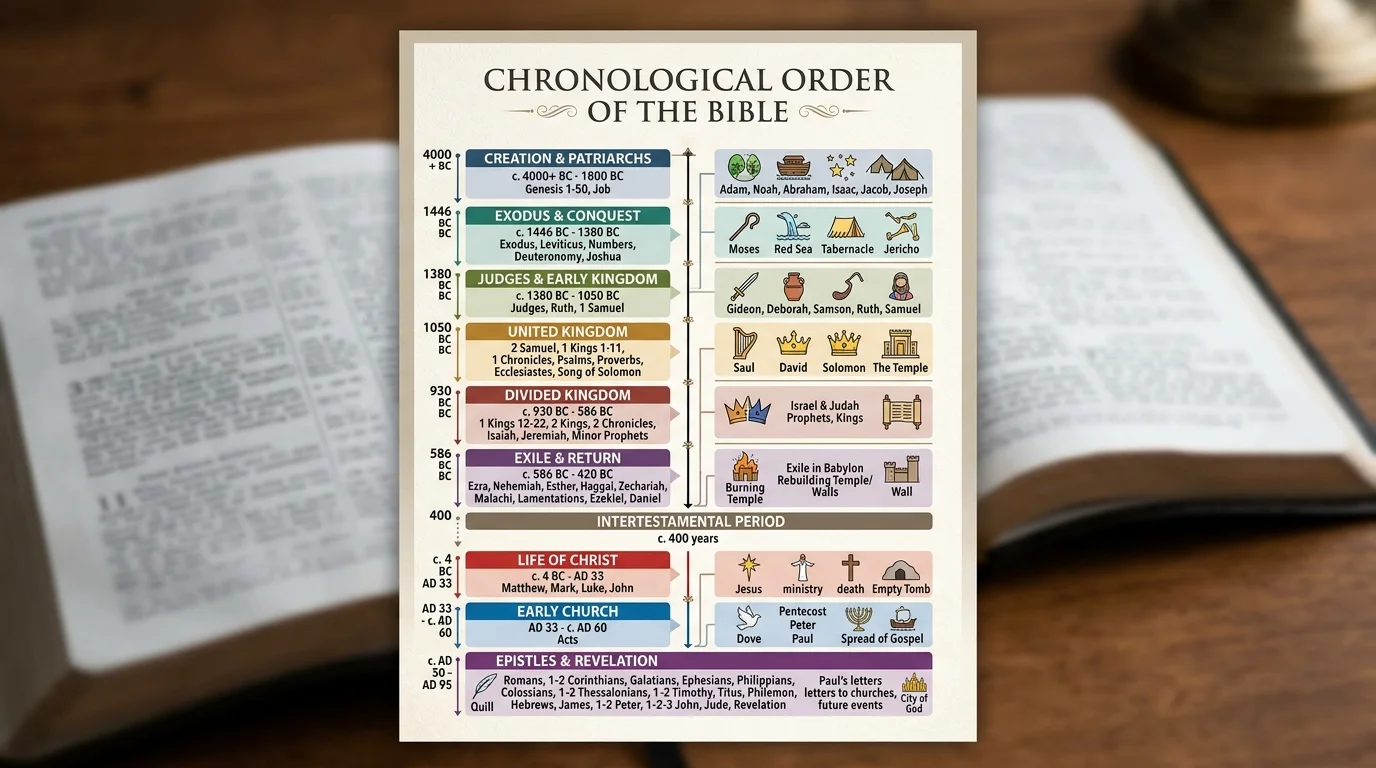
The following chart presents the Bible books in approximate chronological order based on when the events they describe took place.
| Time Period | Bible Books |
|---|---|
| Creation and Early History | Genesis |
| Israel’s Exodus | Exodus, Leviticus, Numbers, Deuteronomy |
| Conquest of Canaan | Joshua |
| Period of the Judges | Judges, Ruth |
| United Kingdom | 1 Samuel, 2 Samuel, 1 Chronicles, Psalms |
| Solomon’s Reign | 1 Kings 1–11, 2 Chronicles 1–9, Proverbs, Song of Solomon, Ecclesiastes |
| Divided Kingdom | 1 Kings 12–22, 2 Kings, 2 Chronicles, Joel, Jonah, Amos, Hosea, Isaiah, Micah, Nahum, Zephaniah |
| Babylonian Exile | Jeremiah, Lamentations, Habakkuk, Ezekiel, Daniel |
| Return from Exile | Ezra, Haggai, Zechariah, Esther, Nehemiah, Malachi |
| Life of Jesus | Matthew, Mark, Luke, John |
| Early Church | Acts |
| Paul’s Letters | Galatians, 1 & 2 Thessalonians, 1 & 2 Corinthians, Romans, Ephesians, Philippians, Colossians, Philemon, Titus, 1 & 2 Timothy |
| General Letters | Hebrews, James, 1 & 2 Peter, Jude, 1–3 John |
| Final Prophecy | Revelation |
This chart is suitable for printing and using as a Bible reading companion.
Why Read the Bible Chronologically?
Reading the Bible chronologically offers several benefits.
It Helps You Understand the Timeline
Events become easier to follow when they are read in historical sequence.
It Connects the Prophets with Israel’s History
Many prophets ministered during the reigns of specific kings. Reading them alongside the historical books provides valuable context.
It Shows God’s Plan of Redemption
A chronological reading highlights the unfolding story of creation, covenant, redemption, and restoration throughout Scripture.
It Makes Bible Study More Engaging
Understanding the historical setting helps readers grasp why events happened and how they fit into God’s overall plan.
Major Eras of the Bible Timeline
Creation and the Patriarchs
- Creation
- Adam and Eve
- Noah and the Flood
- Tower of Babel
- Abraham
- Isaac
- Jacob
- Joseph
Exodus and Wilderness
- Moses
- Ten Plagues
- Red Sea Crossing
- Mount Sinai
- Forty Years in the Wilderness
Conquest and Judges
- Joshua leads Israel.
- The Promised Land is conquered.
- Judges lead Israel before the monarchy.
The Kingdom
- Saul becomes Israel’s first king.
- David establishes Jerusalem.
- Solomon builds the First Temple.
Divided Kingdom and Exile
Israel and Judah divide into separate kingdoms before eventually being conquered by Assyria and Babylon.
Return and Restoration
The Jewish people return from Babylon, rebuild the Temple, and restore Jerusalem.
The Life of Jesus
The Gospels record Jesus’ birth, ministry, death, resurrection, and ascension.
The Church Age
Acts and the Epistles describe the spread of Christianity throughout the Roman Empire.
The Future
Revelation concludes the Bible with visions of Christ’s return, final judgment, and the new heaven and new earth.
Tips for Using a Printable Bible Chart
Keep It Inside Your Bible
Use the chart as a bookmark while following a chronological reading plan.
Pair It with a Study Bible
Study notes and cross-references can help explain historical events and cultural background.
Read with a Journal
Write down key lessons, questions, and insights as you progress through the timeline.
Use It in Group Study
A printable chart is an excellent visual aid for Bible studies, Sunday school classes, and family devotions.
Variations & Related Themes
Is the Bible Written Chronologically?
No. The books are arranged primarily by genre rather than by the order in which events occurred.
What Is a Chronological Bible?
A chronological Bible rearranges Scripture so that passages appear in the order the events happened, helping readers follow the historical timeline.
Should I Read the Bible Chronologically?
Many Christians find that reading chronologically improves their understanding of biblical history. Others prefer reading in canonical order. Both approaches can deepen your knowledge of God’s Word.
Frequently Asked Questions
How many books are in the Bible?
The Protestant Bible contains 66 books—39 in the Old Testament and 27 in the New Testament.
Is there an official chronological order of the Bible?
No. Scholars agree on many parts of the timeline, but there are some differences regarding the placement of certain books and events.
Can beginners read the Bible chronologically?
Yes. A chronological reading plan can help new readers understand the historical flow of Scripture.
Is Job the oldest book in the Bible?
Many scholars believe Job may be one of the earliest books written, although opinions differ.
How long does it take to read the Bible chronologically?
Reading for about 20–30 minutes each day allows most people to complete the Bible in approximately one year.
Can I print this chart?
Yes. This simplified chart is designed to be easy to print and use as a study reference.
Faith-Based Action Steps
Pray Before Reading
Prayer:
Heavenly Father, thank You for giving us Your Word. As I read the Bible in chronological order, help me understand the story of Your redemption from Genesis to Revelation. Open my heart to Your truth, strengthen my faith, and teach me to apply Your Word in my daily life. Guide me by Your Holy Spirit and help me grow closer to Jesus Christ. In His name, Amen.”
Follow a Daily Reading Plan
Set aside consistent time each day to read through the Bible while using the chronological chart as your guide.
Study the Historical Context
Use maps, timelines, and study notes to better understand the people, places, and events recorded in Scripture.